Lausha

overview
In a nutshell
Laundry isn't exactly something many people would consider as a particularly exciting topic. However, it is a very worthwhile one to look at when considering potential for improvements in both the overall experience of this "unexciting" chore - and also in resource use.
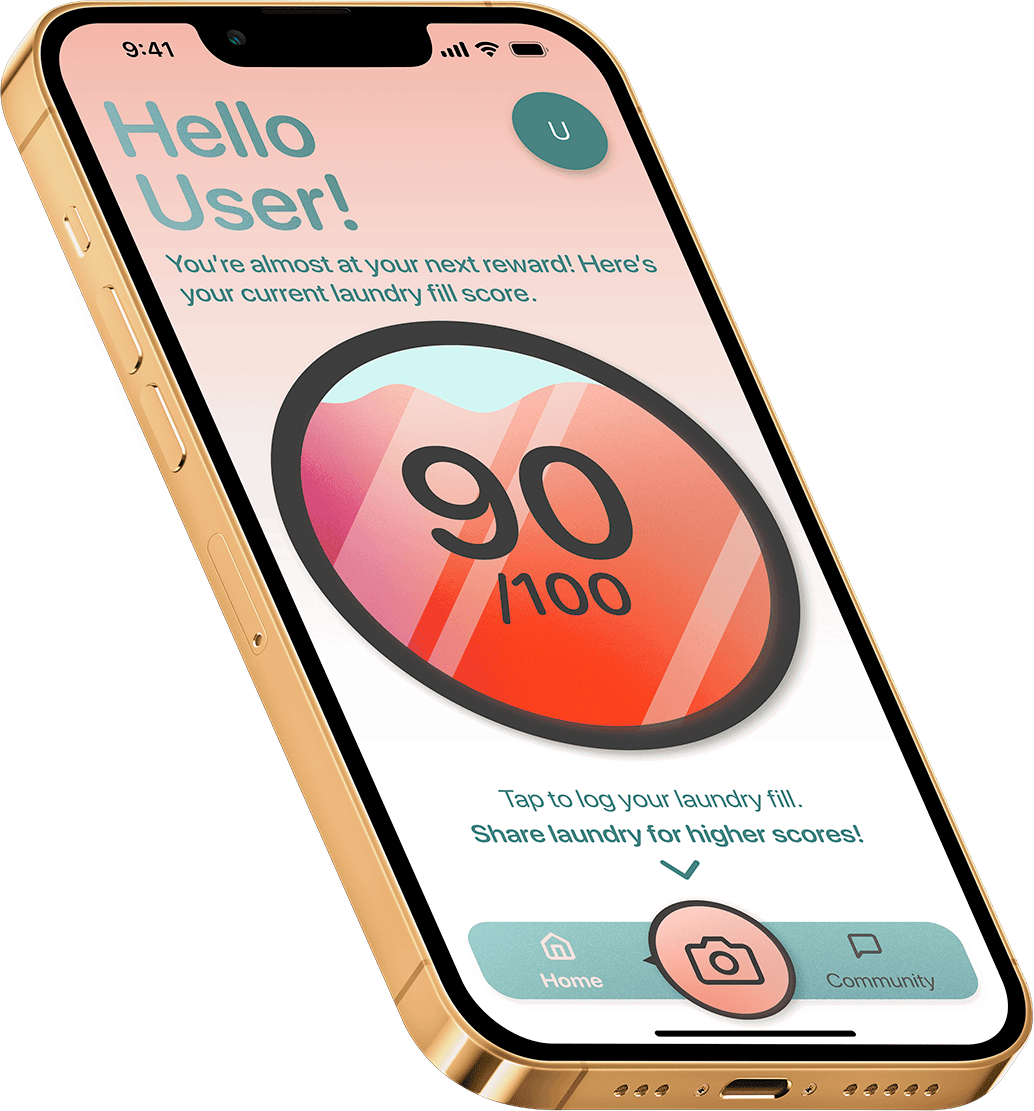
Through primary research, I discovered that university students in shared housing often underfill laundry machines, leading to unnecessary water and energy waste. Lausha is a mobile app designed to encourage more sustainable laundry practices by helping students share loads, track impact, and stay motivated through behavioural nudges and gamification.

8 weeks

Solo UX Designer

Interviews, Observations, Autoethnography, Affinity Mapping, Ideation, Wireframing, User Testing

Miro, Figma, Marvel, Pen & Paper, AEIOU
Individual Academic Project
introduction
The Challenge
Doing laundry is often an individual, mindless task. It's a chore - not really something most people think about too much or immerse themselves into; it just needs to get done. This is especially true for university students, who are often busy day and night or have moved away from home for the first time, making laundry a task where convenience and speed are the major factors shaping their opinions and habits.
What this means? Sustainability is one of the last things on students' minds when doing their laundry, leading to wasteful, resource-heavy laundry practices - this should be addressed.
How might we encourage more sustainable laundry habits among university students living in shared accommodations — without making laundry even more of a chore?
The Approach
Lausha was my first ever end-to-end UX project, which meant I used many of the methods and tools within the project for the first time, rapidly learning and constantly evaluating myself and my design practice throughout the process.
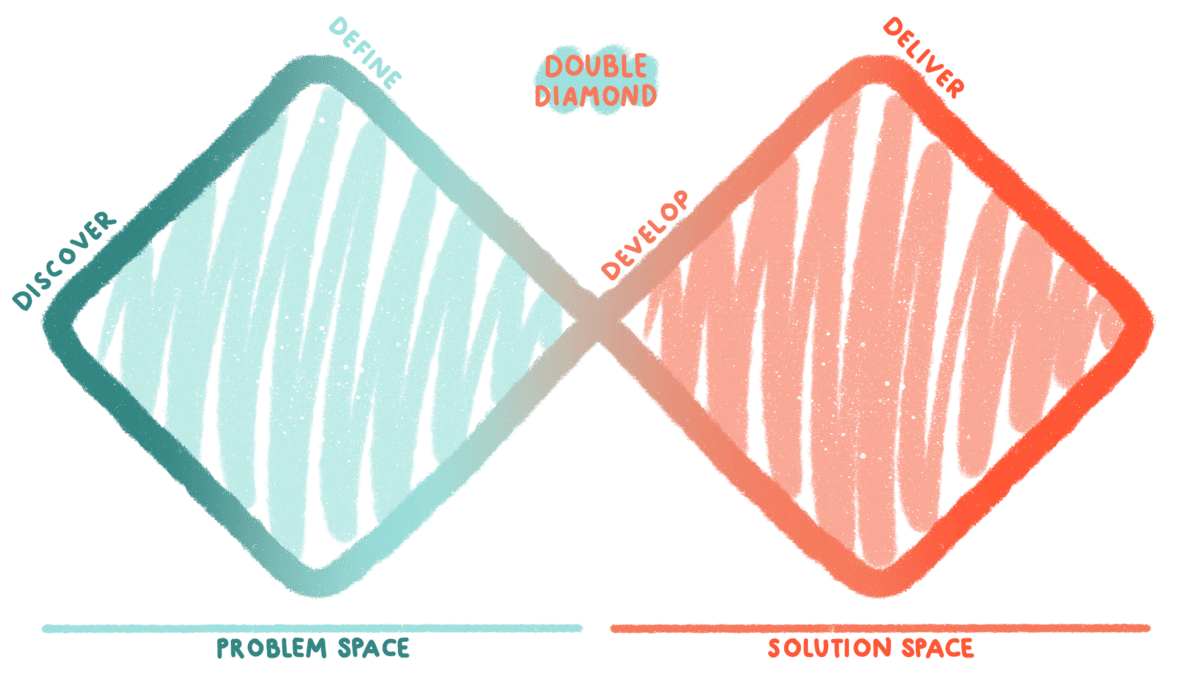
I followed the Double Diamond design process for this project, which helped me get myself into the UX Designer mindset, structure my thinking and stay user-focused throughout without losing sight of milestones and goals.
Throughout the different stages of the Double Diamond, I slowly consolidated my learnings into a validated and higher fidelity concept that not only addressed the sustainability issue but also responded to real user needs - culminating in Lausha, a behavioural intervention designed to make sustainable laundry easy, social, and rewarding.
discover
Primary Research
To really understand how university students in shared accommodations approach laundry and where sustainability challenges arise, I employed a combination of qualitative research methods that allowed me to capture both explicit behaviors and unspoken habits.
I started out with some semi-structured interviews in participants' laundry rooms to learn about my participants' unique experiences. Placing the interviews in-context in the participants' usual laundry environment allowed for them to supplement their answers with gestures and demonstrations, which I found helped them remember details and enhanced the overall quality of my findings.
To supplement this, I carried out video-recorded participant observations during several full student laundry cycles, allowing me to witness natural behaviors and workarounds that might not surface in interviews - think "what people say vs. what people do". I lived in shared accommodation as a student myself during this project, which meant I could consider myself as part of my target user group. I recognised this as an unique opportunity for an autoethnographic session - I could gather my own experiences to enlarge my participant sample while also considering and reflecting upon my own biases and habits within the laundry process.
What I realised throughout these sessions was that laundry is a personal and often very habitual and automatic task, where convenience and efficiency (both time- and cost-wise) are key above all else.
While all these different sessions were happening, I maintained an online graffiti wall on Padlet, which was shared in student chat groups and provided a more anonymous and informal way for students to share attitudes, frustrations, and cultural perceptions around laundry. This allowed me to expand my participant sample significantly and I also saw its potential as a way to mitigate bias within my findings - I could validate that my findings from my small-sample-size interviews and observations were also reflected in a broader, more diverse user group.
These diverse methods were chosen to complement each other - balancing observed behavior with personal reflection and broader sentiment - to form a well-rounded understanding of the problem space before moving on to synthesis in the Define stage.

Interviews
Observations
Autoethnography
Graffiti Wall
define
Insight Synthesis
I came out of my primary research with loads and loads of raw data in different formats and it all had one thing in common - it didn't tell me much. So I had to make sense of it.
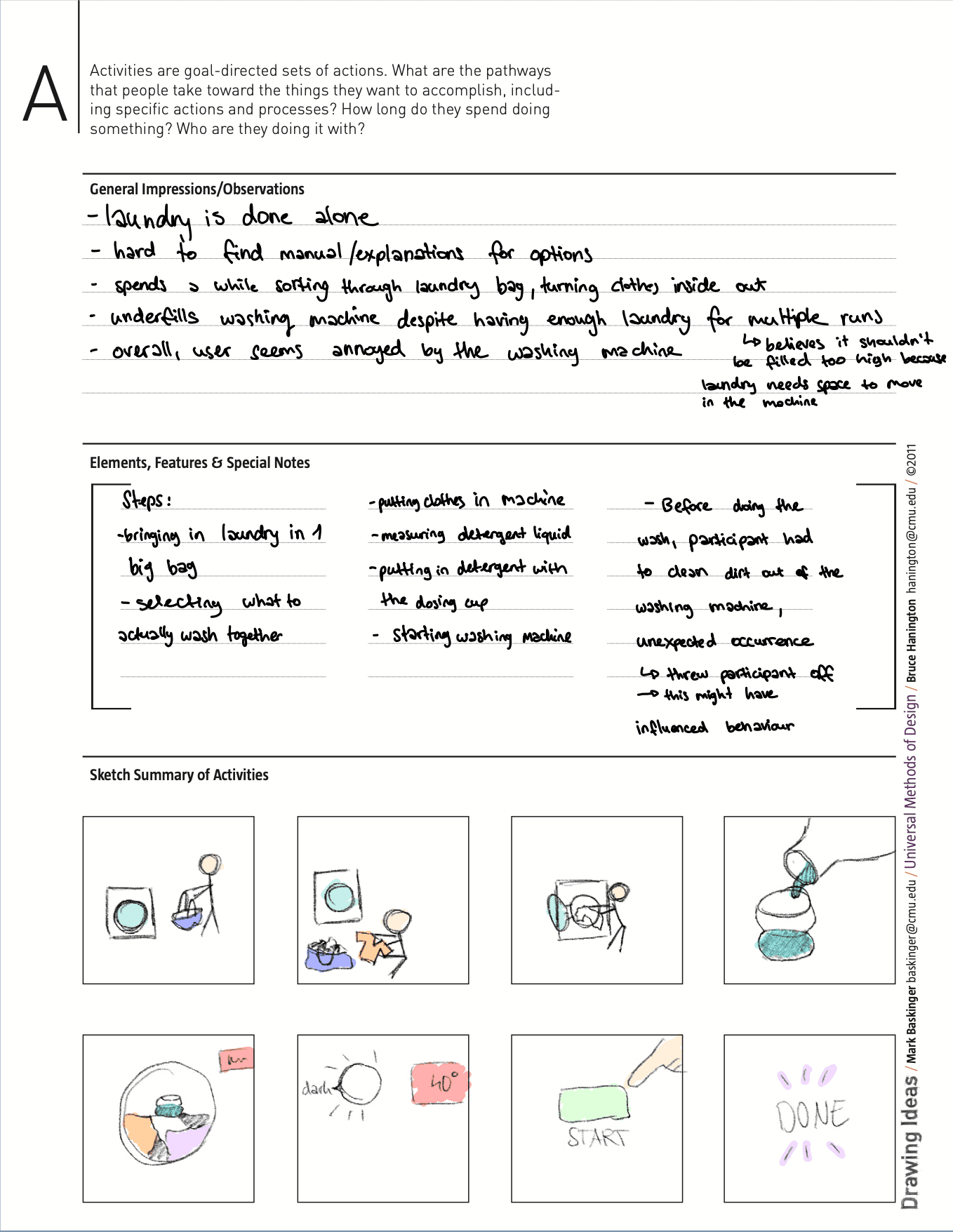
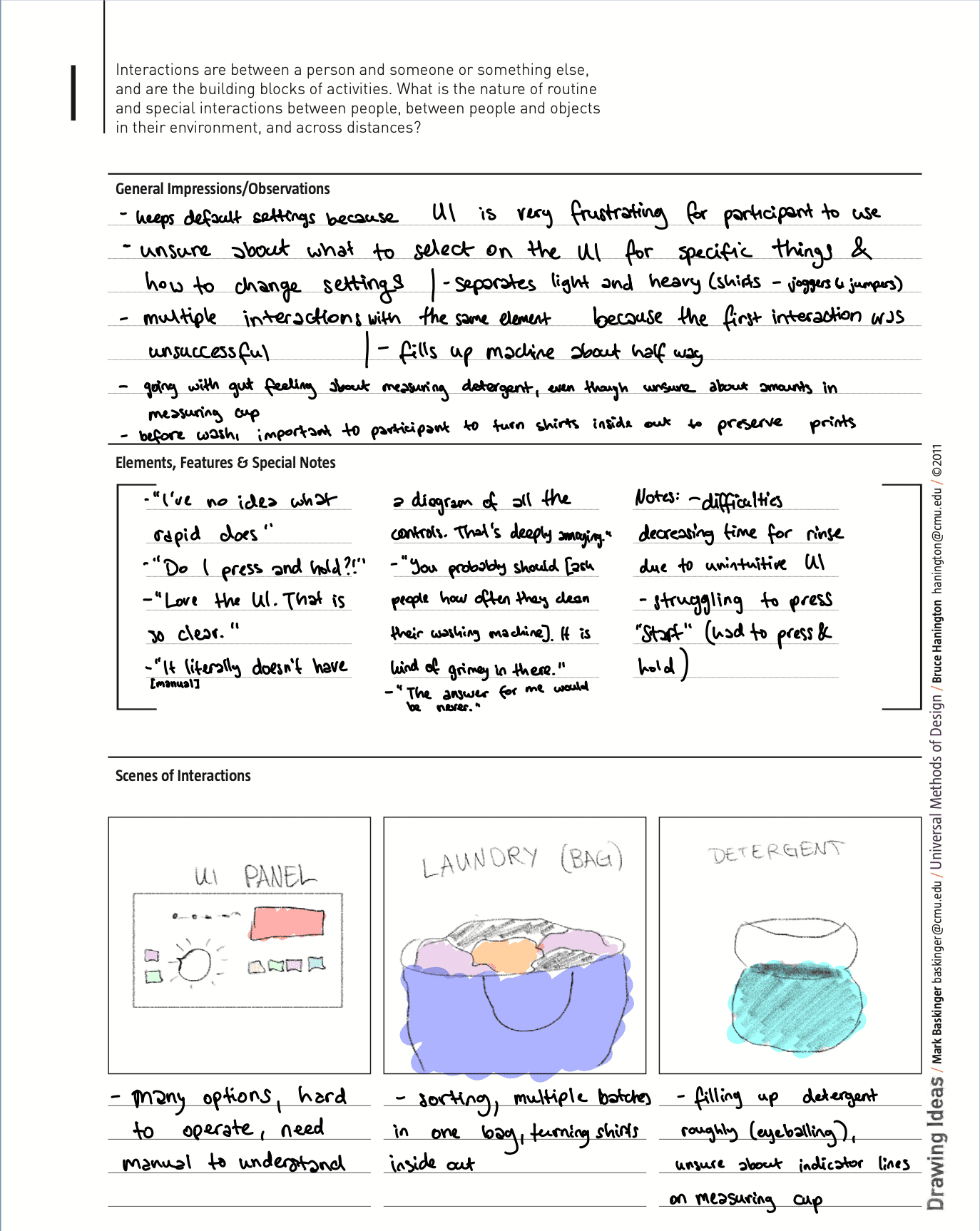
I started by converting quotes from cleaned-up interview transcripts into digital sticky notes on a Miro board that I used as a central place for data analysis and synthesis. The same went for relevant quotes from the graffiti wall. To analyse all my raw video recordings, including from my autoethnographic session, I first followed the AEIOU framework (see example AEIOU worksheets on the side) to help me structure findings and write down relevant quotes from the footage. I then added these quotes and findings to the sticky notes on the board as well.
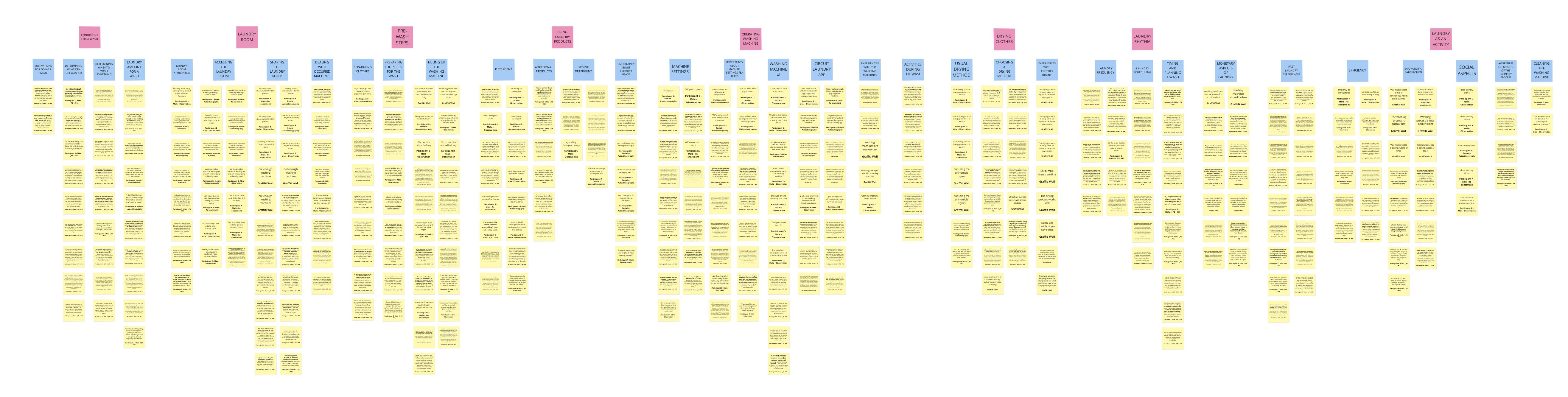
From all these unorganised sticky notes, I began forming theme clusters and finally created an expansive affinity diagram (see the image at the top). As I synthesised the individual quotes and observations into findings for each theme and finally into insights (taking a finding and asking myself "What does it mean and why does it matter?"), my understanding of the laundry process and its underlying challenges and perceptions from students deepened steadily, and after ranking all my insights in a prioritisation matrix, there were two things that particularly stood out to me:
"I use pods. Don't know if that's good, with plastic and all, but it's just the most convenient." (Participant 1)
Students don't really care about sustainability when doing their laundry.
They want to get laundry over with as quickly and work-efficiently as possible, as it is seen as a boring, unavoidable chore. This leads to unsustainable habits being accepted for the sake of convenience.
"Yeah, two weeks worth of laundry right there, just about reaches the minimum line." (Participant 3)
Students routinely underfill the washing machines.
They either haven't collected enough laundry by the time they decide to or need to do a wash, or they do have enough - but the load they choose to wash is small because they believe larger loads won't get washed as thoroughly. Running an underfilled washing machine is a lot less energy-efficient than running it with a full load.
Finding an Opportunity
The first insight validated the realisation and major assumption I had made already throughout the discovery phase. The second insight, however, was something I was surprised to find as a recurring theme within almost all of my participants. Personally, I had experienced not having enough laundry for a full load by the time I really needed to run a wash multiple times, but I hadn't expected this to also be an issue for many other students. And especially the discovery I made that students still underfilled the washing machine even when they could gather enough laundry for a full load was surprising and showed that running underfilled washing machines was a widespread issue caused both by necessity and deep-rooted habit.
I decided that these two core insights about the student laundry process could form the basis for a design opportunity - one that is expressed within this 'How Might We?' statement:
How might we create a design intervention for university students with shared laundry access who don't concern themselves much with sustainability issues and often underfill the washing machine in order for them to wash full loads most of the time?
develop
Ideation
With a clearly defined problem and opportunity space and well-grounded user insights, I moved into the ideation phase. To encourage creative thinking and move beyond obvious solutions, I began with a "What if?" activity, using imaginative prompts to challenge assumptions and explore alternative perspectives. This was followed by a Crazy 8s sketching session, which enabled me to quickly generate a wide variety of concepts through rapid visual thinking.
From this pool of ideas, I identified several promising directions that responded directly to the user behaviours and challenges uncovered during my research. At first, it seemed as if it would become necessary to focus only on one of my two core problem areas - either improving awareness and willingness to make conscious choices for sustainability within the laundry process or making it easy or even mandatory for students to wash full loads. However, I realised that combining aspects from my different ideas would form one concept that could address both - this meant deliberately blending social interaction with behaviour change strategies to make the laundry experience more fun while also nudging users towards more sustainable practices and informing them about the impact of their actions.
The idea:
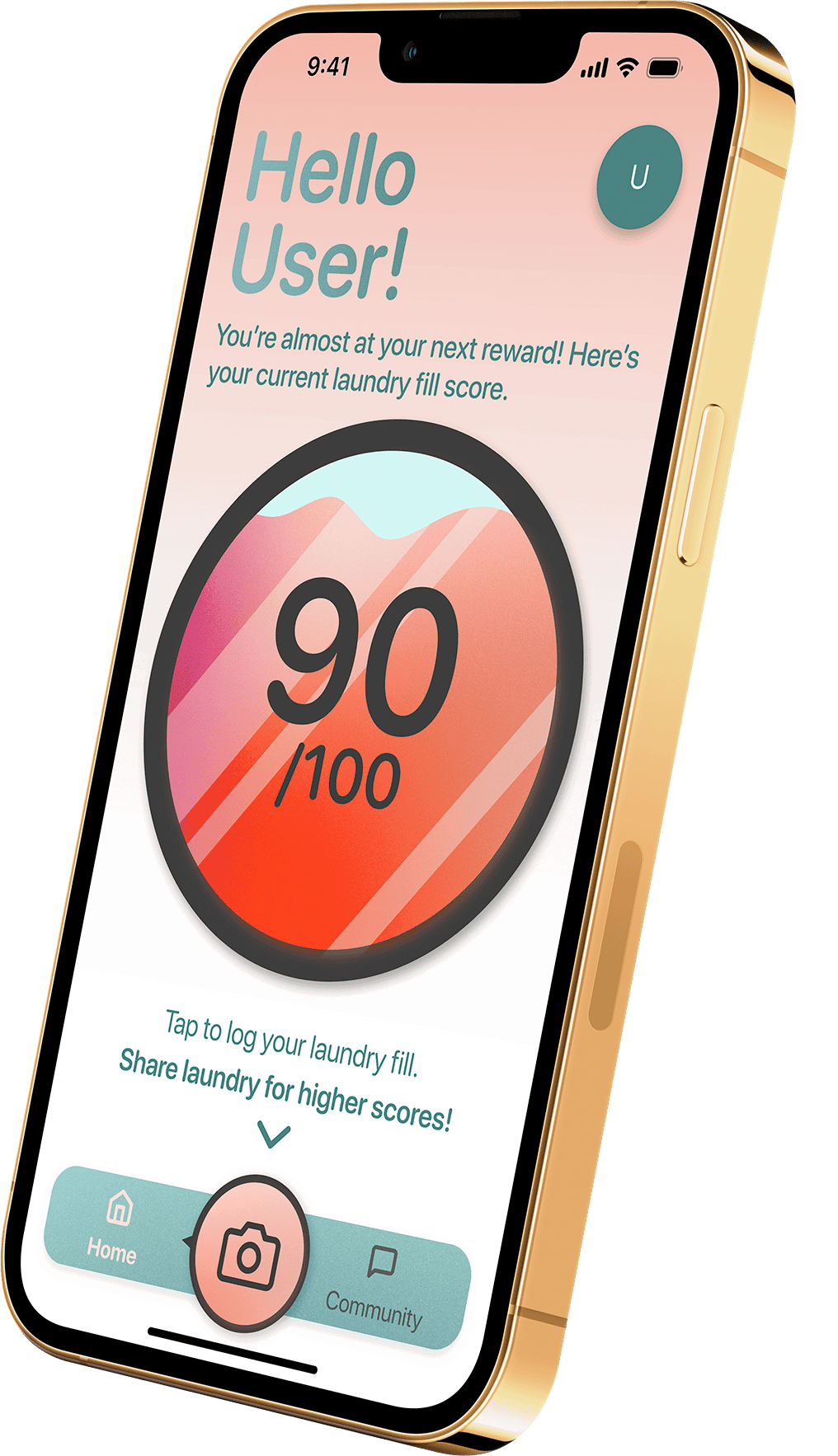
An app enables users to share laundry loads with other users to achieve larger loads together. Before every wash, the user takes a photo of the filled-up washing machine and is given a score depending on how close they got to the optimal fill level of the washing machine, encouraging the formation of sustainable laundry habits. The score directly translates into points that the user collects and that result in awards like a free wash or a free coffee. All this makes the laundry process more social and rewarding, improving the experience and with that also increasing the willingness of students to pay more attention to sustainability within their laundry process.

Gamification
Points, Milestones & Rewards encourage users to aim for optimal fill levels to get more points and to keep using the app to earn rewards like free washes, free drinks, etc.
Feedback
Fill level scoring with higher scores for optimal fill levels and the use of corresponding positive and negative messaging

Behaviour Steering
Notifications & in-app messaging remind and encourage users to use the app and to make use of the community laundry sharing feature; Constraints & affordances in the app's design prevent misuse of features and make the experience simple and intuitive
Low-Fi Wireframing
To begin translating my concept into a tangible design, I developed a low-fidelity wireframe prototype. I initially sketched out the primary user flows on paper, focusing on three key interaction scenarios with the app:
- Logging a suboptimal fill level and receiving negative feedback
- Logging an optimal fill level and receving positive feedback and a reward
- Engaging with the community section of the app to manage laundry shares with other users
This sketching phase allowed me to experiment with different layouts and functionalities quickly, without getting distracted by too much visual polish. One design element I was very sure of at this point and wanted to see a participant's response to was displaying the current point score on the home screen through an indicator that looks like a washing machine drum. This would fill up as points are added, culminating in a reward once the drum was filled completely. I was hoping that his metaphor-based approach in the design would make it stand out, keep it a bit more playful and make the point system very visual and easy to understand.
Once the core structure was in place, I scanned the paper wireframes and digitised them using the Marvel app, where I added basic click-through interactions to simulate the intended experience. This early prototype served as a lightweight but effective way to visualise the concept and prepare for initial user testing.
I then conducted a user testing session with a participant from my target user group to evaluate the prototype's usability and the overall concept. Using the Marvel prototype, I let the participant act through the three key user flows in a laundry room using the 'think aloud' method and presented alternative layout versions for screens to gather feedback on structure and clarity.
Throughout the session, I observed their interactions, took note of questions they asked or things they pointed out in real time, and followed up with a short interview. The participant found the concept itself very engaging, and showed a very positive response to the basic design ideas, especially the washing-machine-drum-like scoring. However, it became clear that the connection between fill-level optimisation and environmental impact - a core goal of the app - was not coming across as strongly as intended. This insight, along with feedback on the need for clearer messaging and guidance and a voiced concern about ensuring user trust in the laundry sharing system, directly informed the development of the mid-fidelity prototype, where I focused on making the purpose and value of the app more explicit and intuitive for users.
deliver
A simple Design System
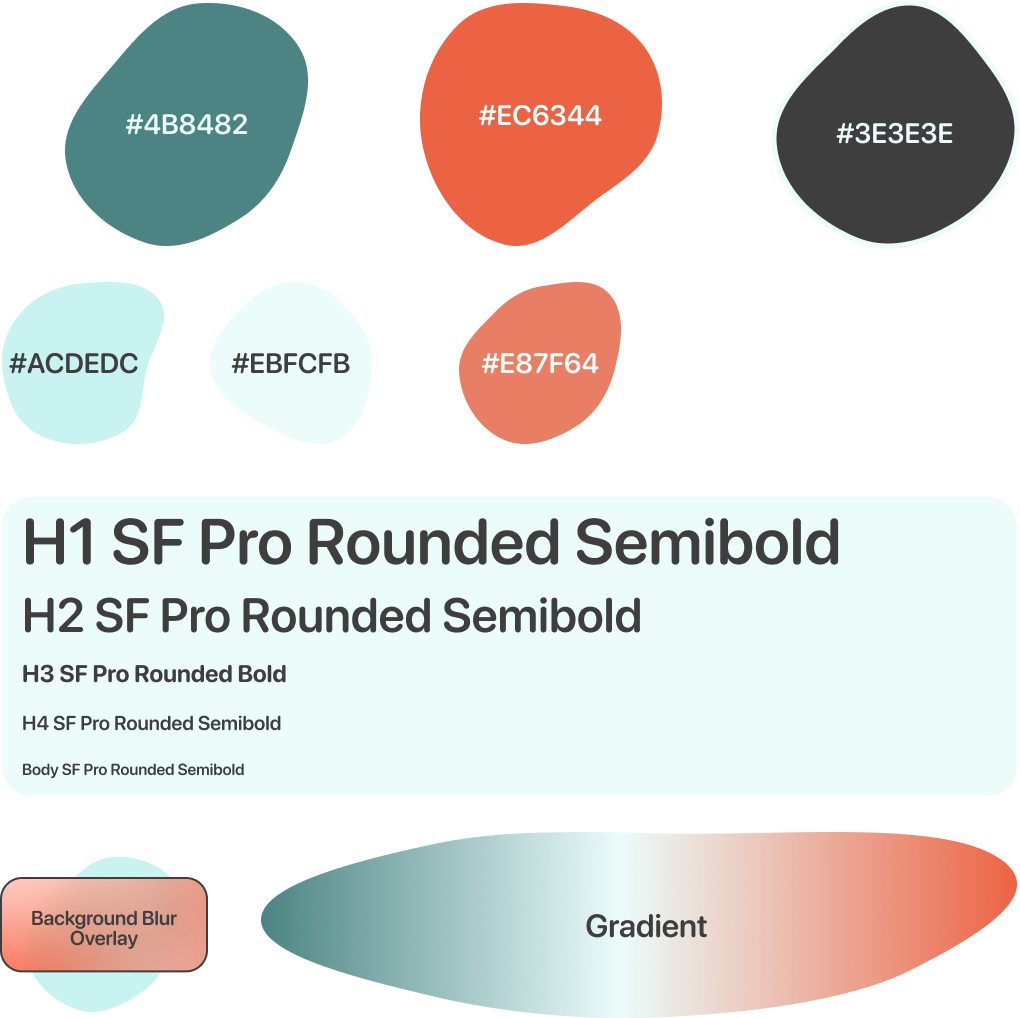
Before implementing concrete concept or layout refinements, I focused on creating a visual language for the mid-fidelity prototype that felt approachable, engaging, and clearly communicated feedback to the user. I selected a teal and orangey-red colour palette - a combination of cool and warm tones that not only provided visual contrast but also served a functional purpose within the app: warm hues were used to convey positive feedback, while cooler tones indicated less optimal outcomes, reinforcing the scoring system's behavioural cues.
To soften the overall look and make the interface feel more inviting, I used a rounded typeface in a dark grey, which offered both readability and a friendly tone. I also incorporated gradients and background blur effects across overlays, backgrounds, and headings, adding a sense of depth and modernity without making the overall design too overwhelming.
Implementing User Feedback
The next step was to respond to the feedback received from the first user test. For that, I made several key adjustments to the features of the app for the development of the mid-fidelity prototype to improve clarity, trust, and alignment with the app's sustainability goals.
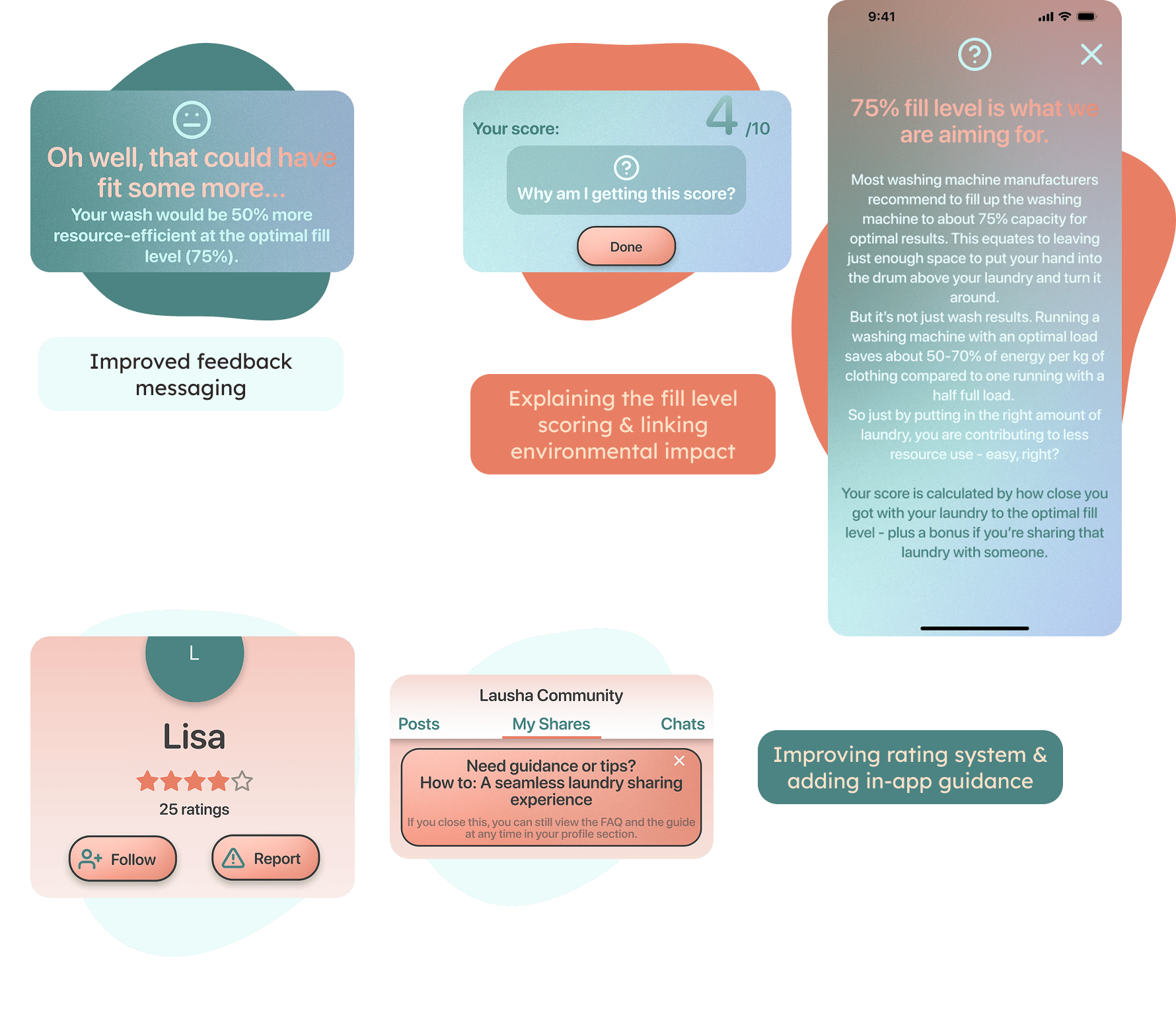
To help users better understand their laundry scores, I refined the feedback system not just by using coded colours, but also by adding a title on the score screen that clearly communicated how efficient the load was, offering more concrete and actionable feedback. I also introduced a “Why am I getting this score?” screen, which users could access for a clear explanation of optimal fill levels and how the scoring system contributes to environmental impact - making the link between user behaviour and sustainability more explicit.
To address concerns around user trust when sharing loads, I implemented contextual guidance prompts within the app and added a user rating count to each profile, helping users assess reliability before agreeing to share. These changes aimed to enhance transparency, reinforce the purpose of the app, and support more confident, sustainable user decisions.
Mid-Fi Prototyping
I conducted further user testing with the mid-fidelity prototype to evaluate how well the updated design communicated the app's purpose and supported user needs. The overall feedback from participants was highly positive - they found the concept engaging, the interface intuitive, and all stated they would be likely to use the app in real life.
Notably, the prototype performed better at communicating the link between fill level optimisation and environmental sustainability, as evidenced by participants' comments during the sessions and in the follow-up interviews. They also showed a general willingness to share loads with others, suggesting that the design changes to build trust—such as added guidance and user rating information—had been effective.
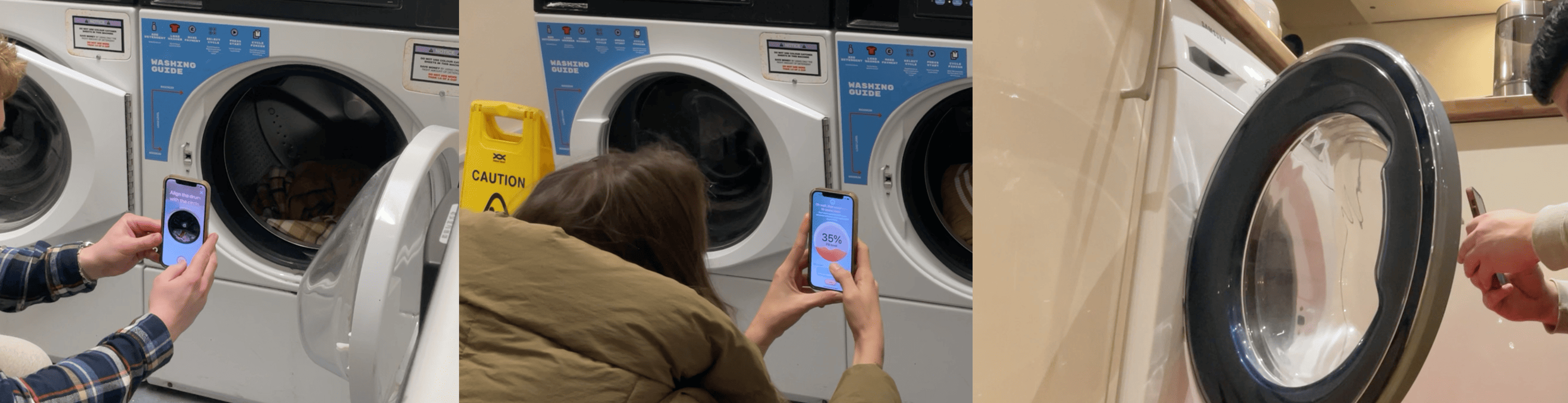
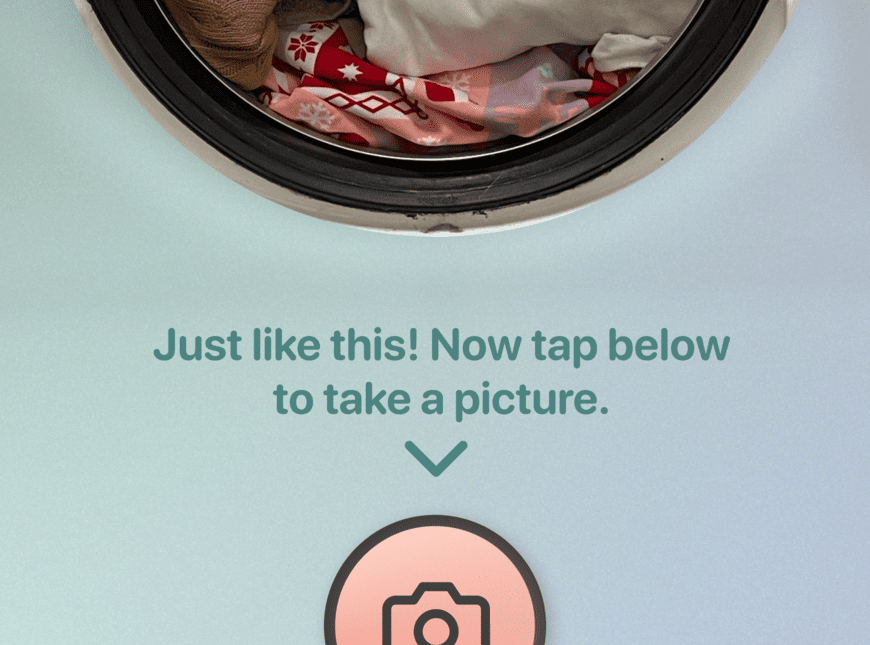
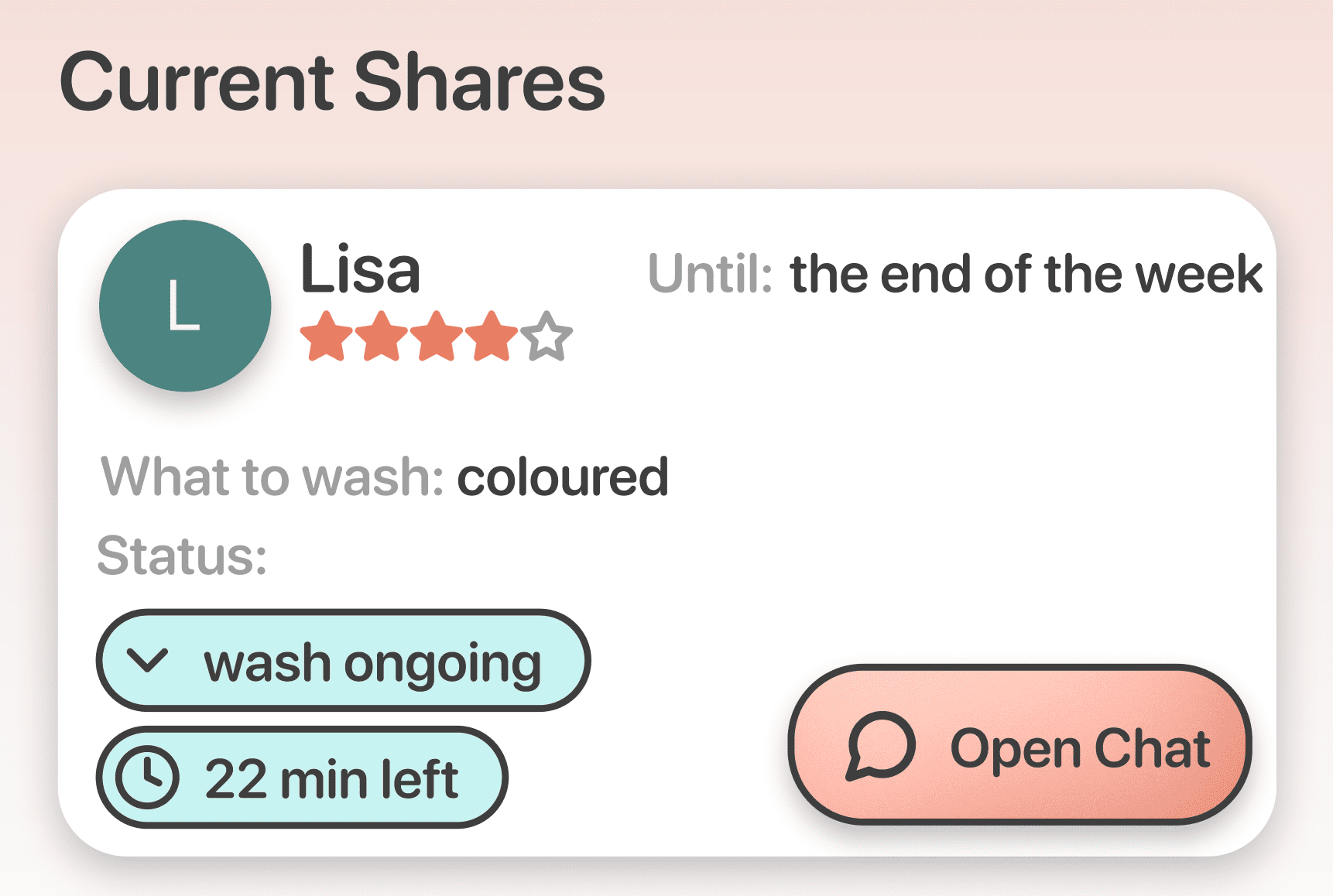
While no major usability issues were raised, participants did suggest a couple of useful improvements. Some expressed concern that their laundry photos might not be properly aligned or clear enough, potentially leading to inaccurate scoring, so I added real-time feedback on the camera screen to reassure users when the photo is suitable for analysis. Others felt it would be helpful to include a timer for ongoing laundry shares, so that users and their partners could keep track of when a shared wash would finish—this feature was also implemented in the updated prototype. These refinements further strengthened the app's usability and overall user experience.
Action 1
Let users know when they have correctly aligned the camera with the washing machine drum through feedback.
Action 2
Add a timer for ongoing washes.
The Final Design
Lausha is a simple 3-step process: find a laundry share partner, wash your clothes together, and earn rewards for achieving an optimal fill level. By encouraging collaboration and providing instant feedback on each load's efficiency, the app makes sustainable laundry habits easy, social, and rewarding.
Gamification
Feedback
Behaviour Steering
reflections
What I learned
I gained a deep understanding of the Double Diamond process and how each phase contributes to creating a user-centred solution. As it was my first full UX project, I followed the four phases in a relatively linear fashion, which helped me grasp the structure without feeling overwhelmed. However, I've since come to appreciate the value of being more flexible and iterative, and in future projects, I would allow myself to move more fluidly between stages as new insights emerge.
Working with a small participant sample due to time constraints and limited local connections was a challenge, but it taught me how to make the most of every research opportunity and be creative in participant recruitment. The biggest shift, however, was a mindset change - coming from a Computer Science background, I had to adapt from a solution-driven approach to a more exploratory, human-centred design process.
This experience has been crucial in shaping how I now approach design problems with curiosity, empathy, a readiness to challenge assumptions, and a drive to create something meaningful.
A word on ethics
The field of designing for behaviour change is not an uncontroversial one. Is it acceptable as a designer to have this power over users to change their usual behaviours to something the designer (or a different stakeholder) considers to be the right one? I believe that any design intervention aiming to change user behaviour must be evaluated not just by its effectiveness in achieving the desired behaviour, but also by whether it does so ethically. For Lausha, I considered many different ethical evaluation factors when developing the concept:
- Were my intent and motivation for designing Lausha ethical?
- Are the behaviour change methods that Lausha uses ethical?
- Is the level of control the user has over Lausha acceptably weighted against its intent and motivation?
- Are the intended outcomes of Lausha ethical and have unintended outcomes been considered and are ethical?
- Have I taken moral responsibility for Lausha as a concept?
I can confidently answer all these questions with 'Yes'. I didn't use any coercive behaviour change strategies, leaving the control with the user at all times and relying more on informing, making the experience fun, and gently nudging - only employing design constraints to make the experience easier and prevent misuse, also addressing potential unintended outcomes. I also believe that my intent and motivation, saving energy in the laundry process and educating about the impact of laundry load size on the environment, are ethical, and are acceptably weighted against the level of control the user has. And I to this day firmly stand behind the concept, taking moral responsibility for it.
In line with an ethical design practice, I of course also made sure that any sessions with participants followed standard ethics practices. Every participant was given a participant information sheet and a consent form before any interviews, observations, or user testing sessions took place.
what's next?
While the project has concluded and was not intended for real-world implementation, there are several features I would explore further if development were to continue. Potential next steps could include integrating an in-app payment system for shared washes, implementing automatic user matching based on schedules and preferences, and adding a historical score overview to help users track their fill levels over time. This data could also enable personalised behavioural nudges, encouraging more consistent sustainable habits. These additions would further enhance the app's functionality and deepen its impact on user behaviour.
